Velocity Source#
This subsection allows you to define velocity-dependent source terms. Two families of velocity source terms are supported: rotating frames and permeability models. They respectively enable you to simulate problems in a Lagrangian reference frame where Coriolis and centrifugal forces must be taken into account, and problems that include solid-liquid phase-changes.
Rotating Frame#
Rotating frame simulations use the following parameters:
subsection velocity source
  set rotating frame type    = none
  set omega_x                = 0
  set omega_y                = 0
  set omega_z                = 0
end
The
rotating frame typeparameter specifies the type of reference frame that is selected. The options arenonefor an Eulerian reference frame orsrffor a single rotating frame. By selectingsrfthe additional contributions of the centrifugal force and Coriolis force induced by the rotating movement are taken into account in the Navier-Stokes equations.The
omega_xparameter is a double representing the \(x\) component of the angular velocity of the reference frame.The
omega_yparameter is a double representing the \(y\) component of the angular velocity of the reference frame.The
omega_zparameter is a double representing the \(z\) component of the angular velocity of the reference frame.
Permeability Models#
A permeability source term can be added to the simulation using the following parameters:
subsection velocity source
  set permeability model                    = none
  set enable Darcy multiply by density      = false
  set Carman-Kozeny fluid with phase change = fluid_0
  set Carman-Kozeny permeability area       = 1e-3
  set Carman-Kozeny division tolerance      = 1e-3
end
The
permeability modelparameter specifies the type of penalization term to be applied to the Navier-Stokes equations. The options arenone,darcy_phase_change, orcarman_kozeny_phase_change.Caution
The phase change Darcy and Carman-Kozeny models do not currently have a Cahn-Hilliard implementation.
Darcy Phase Change#
The darcy_phase_change model uses the values of the Darcy penalty liquid and Darcy penalty solid set-up within the phase change subsection of the Physical Properties. The added source term corresponds to:
\[\boldsymbol{F}_\mathrm{Darcy} = K \boldsymbol{u}\]where
\(K= \alpha_\mathrm{l}K_\mathrm{l} + (1-\alpha_\mathrm{l})K_\mathrm{s} \, [\mathsf{T^{-1}}]\) is the liquid fraction \(\left(\alpha_\mathrm{l} \right)\) weighted Darcy penalty with \(K_\mathrm{l}\) and \(K_\mathrm{s}\) respectively the Darcy penalty in the liquid and the solid phases;
\(\boldsymbol{u} \, [\mathsf{LT^{-1}}]\) is the velocity.
The
enable Darcy multiply by densityparameter enables the multiplication by the density within the Darcy force term (\(\boldsymbol{F}_\mathrm{Darcy}\)). This is for dimensional consistency when solving the pressure (\(p\)) rather than the kinematic pressure (\(p^* = p / \rho\), with \(\rho\) the density of the fluid) in the momentum equation. This parameter should be used when coupling of the CLS equation with the incompressible Navier-Stokes equations.\[\boldsymbol{F}_\mathrm{Darcy} = \left(\rho K\right)_\mathrm{eff} \boldsymbol{u}\]where
\(\left(\rho K\right)_\mathrm{eff} = (1-\phi)\rho_0 K_\mathrm{0} + \phi \rho_1 K_\mathrm{1}\) is the effective Darcy penalization coefficient. It corresponds to the weighted product of the Darcy penalty \(\left(K_i \, [\mathsf{T^{-1}}]\right)\) and the density \(\left(\rho_i \, [\mathsf{M L^{-3}}]\right)\) by the phase indicator (\(\phi\)). If the
phase_changemodel is enabled in a fluid, the Darcy penalty in this fluid is computed with the penalty values in the liquid (\(K_{i\mathrm{,l}}\)) and solid (\(K_{i\mathrm{,s}}\)), and the liquid fraction (\(\alpha_\mathrm{l}\)): \(K_i = \alpha_\mathrm{l}K_{i\mathrm{,l}} + (1-\alpha_\mathrm{l})K_{i\mathrm{,s}}\), and;\(\boldsymbol{u}\) is the velocity vector.
Carman-Kozeny Phase Change#
The carman_kozeny_phase_change uses the Carman-Kozeny permeability area, the Carman-Kozeny division tolerance, the kinematic viscosity specified in the the Physical Properties and the liquid fraction (\(\alpha_\mathrm{l}\)) to compute it’s penalty. The added source term corresponds to [1]:
\[\boldsymbol{F}_\mathrm{Carman-Kozeny} = \frac{\nu}{A_\mathrm{perm}} \left[ \frac{(1-\alpha_\mathrm{l})^2}{(\alpha_\mathrm{l})^3 + \delta}\right] \boldsymbol{u}\]where
\(\nu \, [\mathsf{L^2T^{-1}}]\) is the kinematic viscosity;
\(A_\mathrm{perm} \, [\mathsf{L^2}]\) is the permeability area;
\(\delta\) a tolerance to avoid division by zero in the solid, and;
\(\boldsymbol{u} \, [\mathsf{LT^{-1}}]\) is the velocity.
Note
Here, the kinematic viscosity is used instead of the dynamic viscosity alike [1], since in the single fluid formulation of the Navier-Stokes equations, we solve for the kinematic pressure (\(p^* = p / \rho\), with \(\rho\) the density of the fluid) rather than the pressure (\(p\)).
The figure below gives an idea of how the different parameters influence the resulting force term. It can be seen that for different values of \(\delta\), the evolution of the Caraman-Kozeny force magnitude (\(\lVert \boldsymbol{F}_\mathrm{Carman-Kozeny} \rVert\)) varies mostly within the range \(\alpha_\mathrm{l} \in [0,0.5]\).
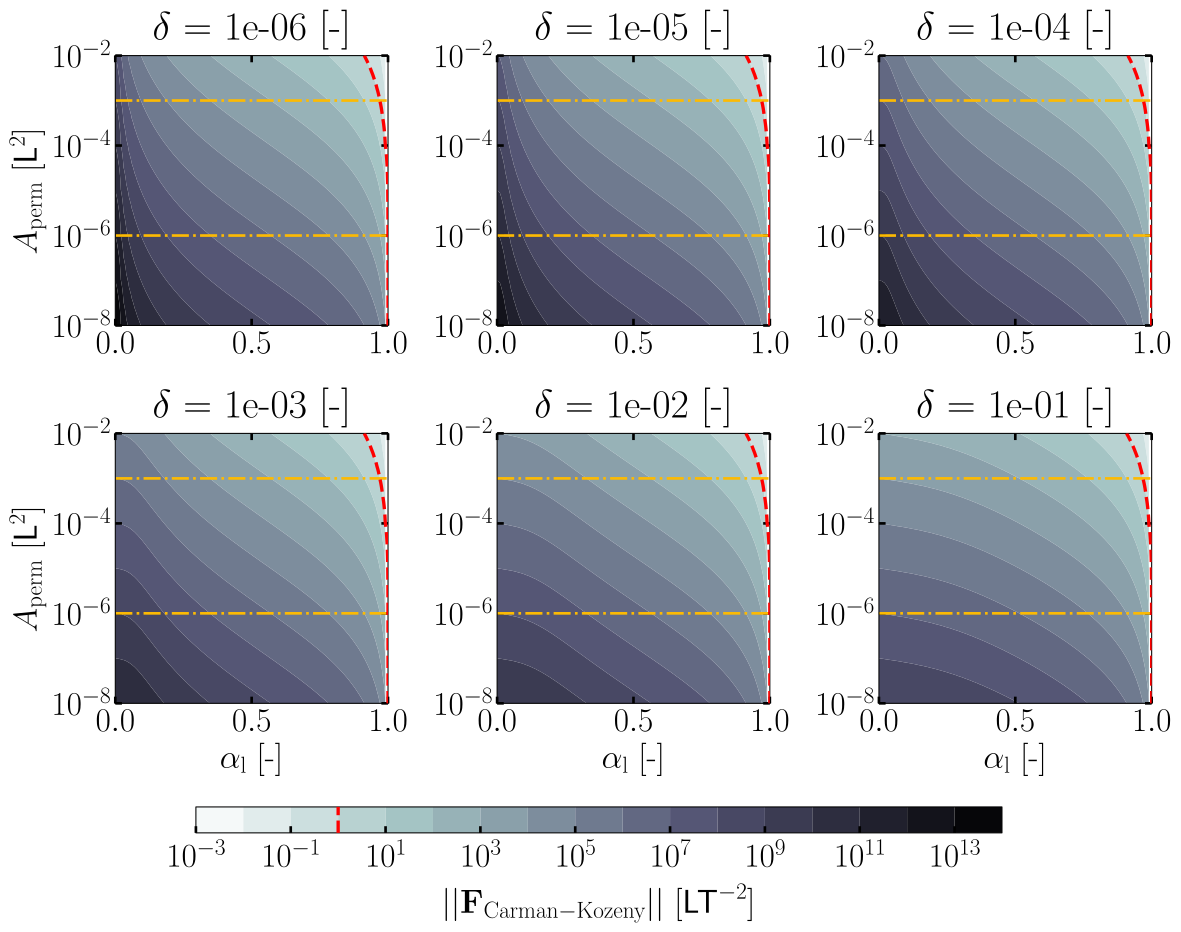
Evolution of the Caraman-Kozeny force magnitude (\(\lVert \boldsymbol{F}_\mathrm{Carman-Kozeny} \rVert\)) in function of the liquid fraction, the permeability area, and the tolerance parameter for \(\nu = 1\), \(\rho =1\), and \(\lVert \boldsymbol{u} \rVert = 1\). The red curve highlights the iso-contour \(\lVert \boldsymbol{F}_\mathrm{Carman-Kozeny} \rVert = 1\). The orange horizontal lines delimit the range of typical \(A_\mathrm{perm}\) that could be used, in this case \([10^{-3},10^{-6}]\). |
For CLS simulations, the source term takes the following form:
\[\boldsymbol{F}_\mathrm{Carman-Kozeny} = \left[ \sum_{i=0}^1 \frac{w_i \mu_i}{A_{i,\mathrm{perm}}} \left[ \frac{(1-\alpha_{i,\mathrm{l}})^2}{(\alpha_{i,\mathrm{l}})^3 + \delta}\right] \right] \boldsymbol{u}\]where
\(w_i = \begin{cases} 1-\phi \quad &\mathrm{if} \quad i = 0\\ \phi \quad &\mathrm{if} \quad i = 1\\ \end{cases}\) is the phase indicator weight, and;
\(\mu \, [\mathsf{ML^{-1}T^{-1}}]\) is the dynamic viscosity.
The
Carman-Kozeny fluid with phase changespecifies on which fluid(s) the permeability model should be applied on. The options arefluid_0,fluid_1, orboth.Note
This only affects the
carman_kozeny_phase_changepermeability model. For thedarcy_phase_changemodel, the penalization is computed according to theDarcy penalty liquidandDarcy penalty solidas described above.Attention
When
Carman-Kozeny fluid with phase changeis set tofluid_1orboth, ensure that theclsphysics is enabled in the Multiphysics subsection.The
Carman-Kozeny permeability areaparameter corresponds to \(A_\mathrm{perm}\) in \(\boldsymbol{F}_\mathrm{Carman-Kozeny}\). It represents the permeability area of the pseudo-porous bed (or solid phase) that is simulated. Typically the value of \(A_\mathrm{perm}\) is chosen in function of \(\mu\), such that \(\frac{\mu}{A_\mathrm{perm}} \in [10^{3}, 10^{6}]\).Caution
When
Carman-Kozeny fluid with phase change = both, two values ofCarman-Kozeny permeability areaseparated by a comma must be specified. The first value corresponds tofluid 0, and the second tofluid 1.The
Carman-Kozeny division toleranceparameter avoids division by zero in \(\boldsymbol{F}_\mathrm{Carman-Kozeny}\) when in the solid phase (\(\alpha_\mathrm{l} = 0\)). Typically, \(\delta \in [10^{-3},10^{-6}]\).Caution
When
Carman-Kozeny fluid with phase change = both, two values ofCarman-Kozeny division toleranceseparated by a comma must be specified. The first value corresponds tofluid 0, and the second tofluid 1.